
Spring Session Wrap-Up: Fast Bills, Closed Committees, and Secrecy by Default
Rushed bills & closed-door committees, the Information Commissioner's warning on access-to-information reform, Alberta's new study on the cost of leaving Canada, and upcoming events in Calgary Shepard

This was the final week before the summer recess. Parliament now recesses for the summer and MPs return to their ridings to continue their work attending events, marking important local milestones and meeting with citizens. Before I trade the Chamber for community barbecues and the Stampede grounds, I want to give residents a plain language account of what the legislative agenda looks like at this time. Some of what passed reaches your kitchen table: grocery relief, housing, and the rising cost of carrying the federal debt. I’ll get to all of it. But the “how” is where this session stood out, so let me start there.
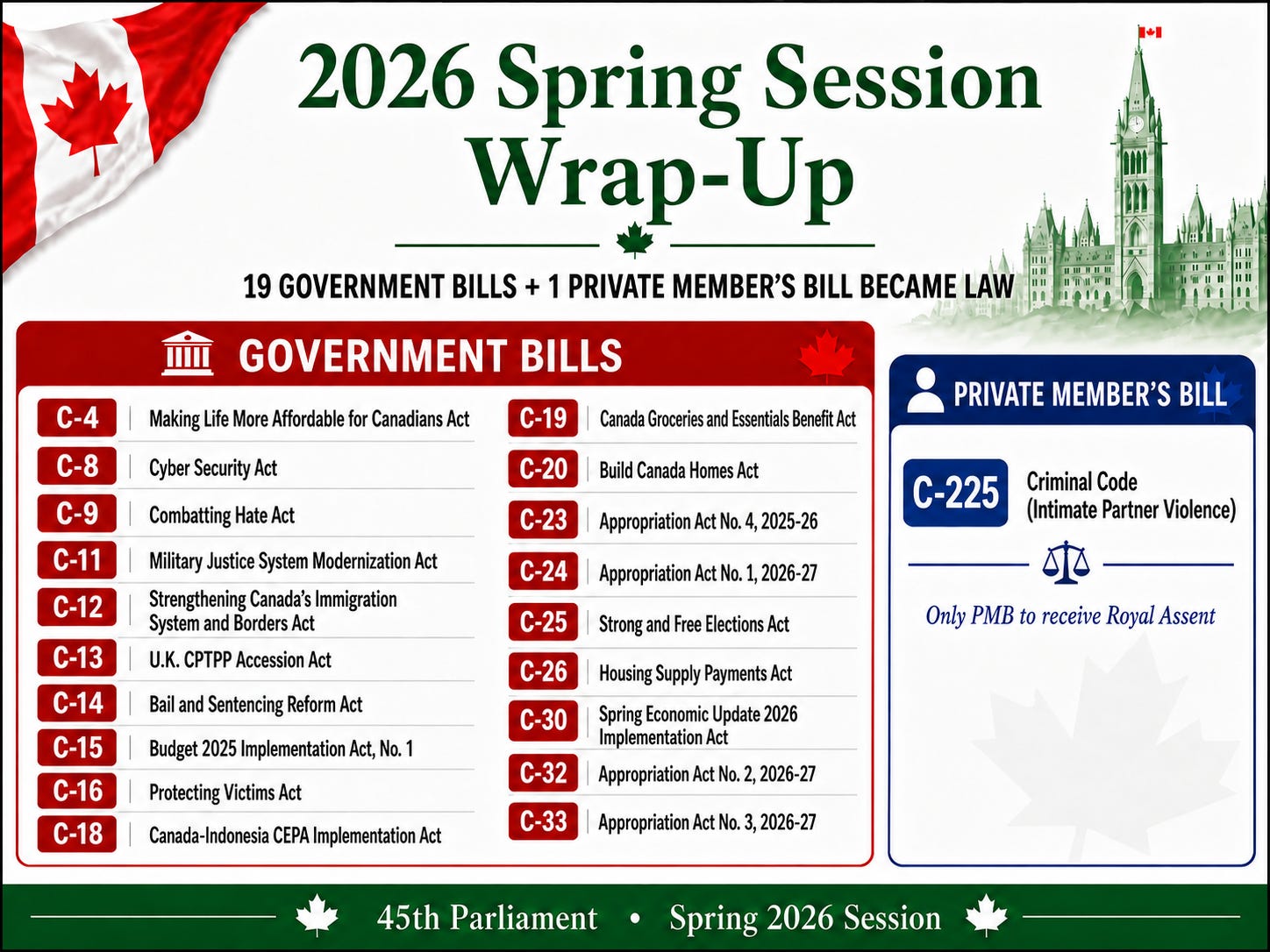
The headline numbers first. Nineteen government bills received Royal Assent in 2026. Only three private members’ bills cleared Parliament, with just one of those becoming law, all three sponsored by Conservative MPs. Two themes run through the rest of this update: the pace at which the federal government moved its bills in the final two weeks, and how often parliamentary committee meetings were forced into closed door meetings by Liberal MPs. The first indicates a growing authoritarian streak in governance with guillotine motions to shutdown debate being used liberally and the latter is the growing culture of secrecy as well as the diminishing reflex that public scrutiny is a good thing.
Start with the pace. The federal government has two procedural tools for limiting debate. Time allocation sets a fixed cap on debate hours for a bill, after which the votes are taken regardless of how many MPs still wish to speak. Closure is the blunter version, a motion that debate “not be further adjourned,” forcing the vote that same sitting which typically means that same day. Both also shorten the window for MPs to raise concerns, test the Liberal government’s reasoning, and move amendments before a vote is forced. Between June 1 and June 18, these tools were used eight times: six time-allocation motions on Bills C-31, C-16, C-20, C-25, C-14, and C-9, and two closure motions on the government business tied to Bills C-30 and C-26. Sitting hours ran late into the evening across that stretch as well. I’ll be candid: I put real value on letting legislation get the full measure of debate, because that is how flaws get caught before they become law. I would have preferred fewer of these motions crowded into the closing days. Opposition MPs called it ramming bills through; the government called it clearing the order paper also more simply the legislative agenda before recess. The count is the count, and residents can weigh the benefit-cost value when legal problems arise later on.
The most contested bill of the session was Bill C-9, the Combatting Hate Act, which amends the Criminal Code on hate propaganda, hate crime, and access to religious and cultural places. It first passed Parliament at third reading on March 25 by 186 to 137. The Senate returned it with an amendment narrowing one clause to specific symbols, including the Nazi Hakenkreuz, the SS bolts, and a noose. Parliament agreed to that amendment on June 16 by 189 to 128, with time allocation applied to the final stage the day before. Hundreds of religious communities and civil-liberties groups raised serious objections about the bill’s reach into religious expression, concerns I think deserve to be taken seriously, while the federal government insisted it strengthens protections against hate. Because it touches Charter rights directly, the courts will likely have the final word on parts of it. A Senate committee amendment to make residential school denialism a crime was added to the law but the Senate as a whole voted that amendment down before sending C-9 back to MPs in the House of Commons for that final vote.
A few other bills are worth pulling out, grouped by how they moved.
Bills that sat idle, then got rammed through. Bill C-9 sat in committee for five months, from October to March, then waited again in the Senate until June 4 and once the Senate sent it back with amendments, Parliament dealt with it in the final week, June 11 to 17. Bill C-16 went seven weeks before second reading even started, sat in committee another six weeks, then sat untouched for a month before everything from report stage to Royal Assent, Senate included, was finished in ten days, June 8 to 18. Bill C-20, the Build Canada Homes Act and the one tied most directly to housing costs here at home, went quiet for six weeks after committee before report stage, third reading, the Senate, and Royal Assent were all completed in thirteen days, June 5 to 18. That’s the pattern worth watching: long stretches with no legislative action, followed by a sprint to the finish line.
The clearest illustration came on the last sitting day before recess. The Government House Leader moved a single motion, adopted by unanimous consent, that disposed of five bills at once. The most notable is that four government bills were each deemed agreed to “on division” — a term that means no recorded vote was taken and that a majority of MPs agreed while some dissented but agreed they did not have the votes to vote down the bill. Bill C-22, on lawful access, was deemed through both report stage and third reading in that one motion. Bill C-27, a self-government indigenous agreement, was likewise passed through. Bill C-11, on military justice, had its Senate amendment deemed adopted. Bill C-29, which establishes a Financial Crimes Agency, was deemed read a second time and sent to the parliamentary justice committee for further study.
On the private members bills’ side, the arithmetic is worth looking over in terms of productivity and focus areas for MPs. Of all the PMBs introduced this session, three made it through Parliament and one became law — all three Conservative. Bill C-225, from my colleague MP Caputo, strengthens the Criminal Code’s response to intimate partner violence; it passed second reading 325 to 0, with every party in support, and received Royal Assent on June 17, the only PMB to make it all the way. Bill C-234, from MP Aboultaif, establishes a Living Donor Recognition Medal and is now in Senate committee after passing third reading April 22. Bill C-230, from MP Chambers, would create a debt-forgiveness registry under the Financial Administration Act to force the CRA to disclose when it writes off large tax amounts owing from people and businesses; it cleared third reading May 7 and is also before the Senate.
Now to the part of the session that troubled me most, and it was at parliamentary committees. Committees do Parliament’s detailed work, and most of it happens in public as it should. On several occasions this spring after the federal government gained a majority and reformed the committee memberships to gain control it proceeded by motions to go in-camera meaning no records were kept of debate or decisions made then. Committees shut off the cameras, the public is asked to leave the room, and no transcript of that portion is published. The secret transcript is held in the Clerks office and held there for 30 years behind closed doors for review by MPs only. Other times, motions to end debate were passed by the Liberal government majority. The common thread was the subject matter. The debates that ended up behind closed doors, or cut short, were the ones probing how public money was spent. A motion to have the Auditor General examine PrescribeIT, a roughly $300-million program launched in 2017 to modernize prescriptions, which reporting indicates is used for fewer than five per cent of them was followed by a vote to take the meeting private. A push to scrutinize a $200-million agreement tied to Spaceport Nova Scotia moved off the public record through a procedural shift to drafting instructions. A motion for documents on the Benefits Delivery Modernization project, whose cost reportedly grew from about $1.7 billion to roughly $6.6 billion, was set aside when the committee was redirected to other business. Requests for records on the Port of Montréal expansion, and for regular updates on the Prime Minister’s ethics screen, met the same fate.
The effect was the same each time: a debate residents could have followed in real time happened where they could not see it, and MPs were left unable to discuss publicly what had been said. Opposition members called the practice anti-democratic; a federal cabinet minister responded that the federal government wants committees to stay open. Transparency about how tax dollars are spent should not be a partisan idea, and I find it hard to see the case for closing the doors on exactly those questions. That instinct, to go private when the topic was the government’s own spending and conduct, is the part I have great concerns for the long term health of this Parliament.
Finally, the money, and this is where it comes home. The Estimates, the spending votes that authorize the federal government to operate, framed much of the session’s fiscal debate. The spring economic update projected $65 billion in borrowing this year; the Parliamentary Budget Officer put the figure at $72 billion and called it a “spend now, pay later” approach. Budget 2025 had projected a $38-billion deficit; the figure cited for this fiscal year rose to $67 billion, with the national debt projected to reach $1.63 trillion by 2031. To put that in Calgary terms: servicing the federal debt now works out to roughly $3,400 per household. With an average two-bedroom rent in our city around $1,700 a month, that is the equivalent of about two months’ rent, per family, going to interest alone, before a single program is funded. For households already watching grocery and housing bills, that is the number I keep coming back to.
Every bill I’ve mentioned here, its full progress, the debates at each stage, and how each MP voted, is on the public record. You can follow any of them yourself through the link below.
That’s the session. With Parliament risen, I’m looking forward to spending the summer right here in Calgary and reconnecting with you in person, at community events across Calgary Shepard and, of course, at the Stampede. I’ll post where to find me on my social media accounts through the summer, so we can stay connected between now and the fall sitting. As always, you can reply to this email with your thoughts; I read them, and they shape the points I raise when Parliament returns.
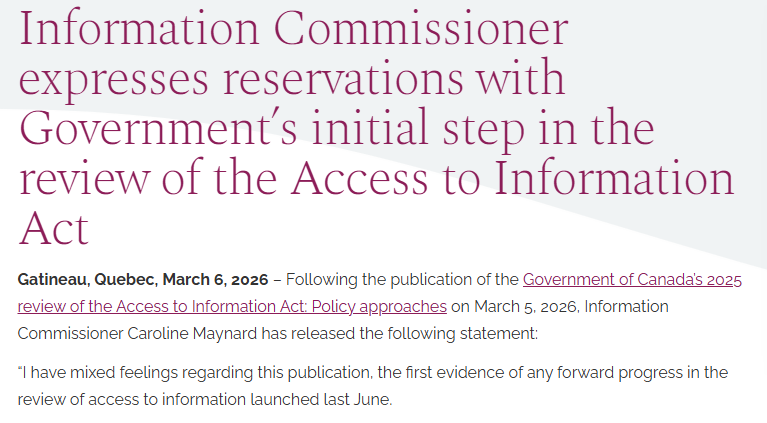
This Liberal government has an emerging problem protecting the value of public scrutiny of laws and decision-making; it’s a developing culture of secrecy and it’s bad news for taxpayers as well as citizens. The Access to Information Act, on the books since 1983, gives Canadians a right to request records from the roughly 265 federal institutions it covers. It’s the tool journalists, researchers, and ordinary residents use to find out what their government is doing with their money, a right the courts treat as quasi-constitutional. I have used this route to gain government documents and have filed hundreds of such requests in the past. The federal government launched a review of it and, on March 5, published proposed “policy approaches” for consultation.
The Information Commissioner of Canada is an independent officer of Parliament who investigates complaints about withheld records and can order the release of those documents. She credited the federal government for consulting her this time. But she said the proposals avoid “the most pressing issue facing the system today: the unacceptable delays experienced by requesters”, was troubled by measures that would limit access to “official records” or delay it during emergencies, and told the President of the Treasury Board she could not support several of the proposals because they put administrative convenience ahead of the public’s right to know.
The wording is the whole game. Much of how decisions get made live in emails, texts, and working documents, not in files stamped “official.” Narrowing definitions and limiting public access helps bureaucrats and not the public understand as well as discover how decisions were made, what factors were considered or who pressed hardest for change or the status quo. To limit access to information from citizens is to protect the federal government and the growing culture of secrecy is worrying.
My colleague conservative MP Stephanie Kusie has presented a petition, e-7284, asking the federal government to withdraw the proposals and fix the delays instead. The consultation closed June 15, with a report to Parliament still to come. Nothing is settled. I’ll be watching when Parliament returns. Transparency about public spending isn’t a partisan cause. You as taxpayers for this work and you have a right to know how decisions were made which this law protects but if the federal government successfully amends the law and procedures then a wall of secrecy will descend to protect the bureaucracy.
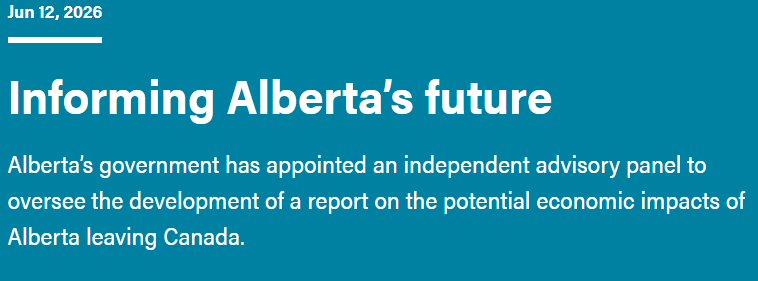
On June 12, Alberta’s government selected the University of Calgary’s School of Public Policy to study the potential economic impacts of the province leaving Canada. It formed a separate advisory panel to review that work ahead of the October 19 referendum. The School’s report is meant to set out the estimated transition costs, the risks, and any potential savings, so Albertans can decide with reliable numbers from a trusted institution. The provincial government has put $1.5 million behind the analysis. I welcome it. In a recent edition I walked through the Premier’s early estimate of what separation could cost, on the order of $80,000 per Albertan up front, plus thousands more each year, and noted the call to hand the analysis to experts working outside the day-to-day of the provincial government. That is now happening.
The School of Public Policy writes the report. A separate advisory panel, led by economist Dr. Jack Mintz, with Ted Morton, Adam Legge of the Business Council of Alberta, Alex Pourbaix of Cenovus Energy, and former Saskatchewan finance minister Janice MacKinnon, then reviews it and delivers its own written assessment, so differing views get aired rather than buried. One caveat I’ll name plainly: several panel members, Mintz and Morton among them, are themselves fellows of the School of Public Policy, so this is less an outside body checking the School’s work than a review carried out largely within the same institution. The provincial government calls the analysis independent and it should be understood as independent of the government that commissioner the report. The report is expected in late summer, leaving time to read and debate it before the vote.
Let me be upfront about two things. First, where I stand: I am voting to stay, and I’ve said so publicly. Second, I know most of the people on this panel, and I consider Dr. Ted Morton a friend and mentor; I worked as his policy advisor during his time as a minister in the Stelmach government. I’ve had several interactions with Dr. Mintz over the years and I’ve worked for Adam Legge when he was CEO of the Calgary Chamber of Commerce, and I was the policy manager there. My confidence in their work doesn’t rest on those relationships. It rests on their record of rigorous, numbers-first analysis.
I’ll add one observation. Much of the work I did working for Dr. Ted Morton, was about securing a fairer deal for Alberta within Canada on equalization, on respect for provincial jurisdiction, on our place in Confederation. Those were arguments for a stronger Alberta in a stronger country. It is striking to hear that same language now turned into slogans for leaving it. The grievances behind them are often real; the conclusion that we’d be better off out does not follow, and I expect the numbers in this report to bear that out. When it lands, I’d encourage every Albertan to read it and decide for themselves on October 19, on the evidence, not the slogans.

In the update above I mentioned spending the summer reconnecting with residents in person. I’ll be at New Brighton Neighbour Day this Saturday (tomorrow), and I’d be glad to see you there.
The community association is hosting it at the New Brighton Bell Tower on Saturday, June 20, from 11:00 AM to 2:00 PM. There’ll be a lemonade stand, chalk art for the kids, and a chance to meet local businesses and elected officials. I’ll have a table with Canada swag and lapel pins to hand out.
One practical note: the event is weather dependent, and heavy weather could cancel it. Before heading over, it’s worth checking the New Brighton Community Association’s Facebook page for the latest status.
Location (New Brighton Bell Tower): https://maps.app.goo.gl/pBk287xDZpCmFwk27
Event details: https://www.facebook.com/events/951339014051706
Weather and status updates: https://www.facebook.com/NewBrightonCA

Canada Day is the next stop on my summer rounds, and it’s a good one. The Mahogany Homeowners Association is hosting its Canada Day Pancake Breakfast, and I’ll be there with my own tent to meet residents and mark our country’s founding together.
It runs Wednesday, July 1, from 9:00 AM to 1:00 PM at the Mahogany Beach Club (29 Masters Park SE). Alongside the pancakes, I’ll be handing out Canada swag and because no one ever turned down cake at breakfast, some cake as well. Quantities are limited and it’s first come, first served, so come by early if you’d like some.
One important note: this breakfast is open to Mahogany residents only. If that’s you, I hope you’ll stop by the tent and say hello. Full details are on the Facebook event page: https://www.facebook.com/events/1523775032865936
That’s a wrap! Resuming Debate is now taking a summer break. The newsletter will be back on September 25, when Parliament resumes but maybe one or twice before then. Until then, you can keep up with the events and meetings I’m attending across Calgary Shepard on Facebook, Instagram, and LinkedIn.
Happy Canada Day, and happy Stampeding!
Thank you for all your hard work Tom
Gerald Tattersall your constituent
Well, isn’t it nice that our government takes the whole goddamn summer off. While we in the independence movement work our butts off and are slammed in every direction. Yeah you want to stay in Canada, but you just finished telling us that you could do nothing to stop these bills that are taking away our freedoms. C9 approved !!! And you’re gonna try and get a fair deal for Alberta ….good luck. Someday maybe when you catch up yourself, you will join us in our fight for a real country. That’s not run by the global Carny communist new world order. Shame on everyone of you for turning your back on Alberta. Have a good holiday.